Loading product literature...
HEPES buffered saline (HBS) is a biological buffer solution used to maintain stable pH and physiological ionic conditions across a variety of life science and analytical workflows. Built around the zwitterionic buffering agent HEPES—part of the Good’s buffer family known for low biological interference—HBS delivers consistent pH control near neutral conditions (≈7.2–7.6), even outside traditional CO₂-controlled environments.
Beyond standard HBS, specialized formulations like HBS-EP, HBS-EP+, HBS-P+, and related saline systems provide enhanced performance for Surface Plasmon Resonance (SPR) and other high-sensitivity interaction studies.
HEPES (4-(2-hydroxyethyl)-1-piperazineethanesulfonic acid) is a zwitterionic buffer that resists pH changes in the physiological range (~6.8–8.2). By itself, HEPES stabilizes hydrogen ion activity, minimizing rapid pH shifts. When combined with saline (e.g., NaCl), the result is HEPES buffered saline (HBS), a solution that also mimics physiological ionic strength for biological systems.
Why “buffered saline”?
Adding saline to a buffer provides isotonic conditions that more closely resemble the fluid environment inside living organisms and cells, which can be important for maintaining protein conformation, cell viability, and accurate measurement in analytical systems.
Typical composition of HEPES buffered saline includes:
The pH is tailored to physiological conditions (often ~7.4) while preserving HEPES’s buffering capacity in the range where many cells and proteins are most stable.
Core Benefits of HBS Composition
Standard HEPES Buffered Saline (HBS)
Best for:
These formulations add chelators and surfactants to the base HBS to enhance performance in Surface Plasmon Resonance (SPR):
Composition Highlights:

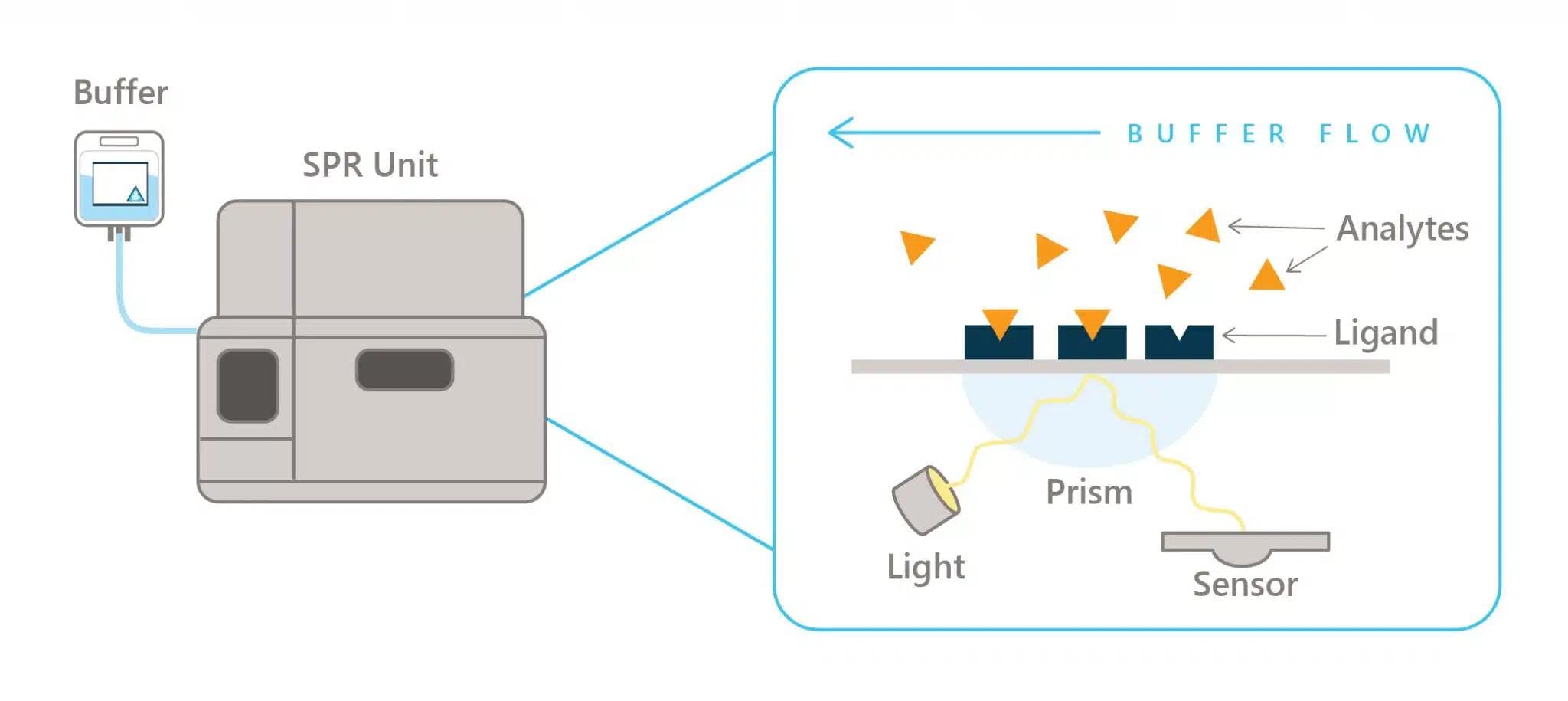
HEPES buffered saline is a key reagent for multiple steps in SPR analysis. SPR, an acronym for surface plasmon resonance, is an analysis technique for assessing binding characteristics and related biochemical dynamics between molecules [1,2]. HEPES buffered saline is used to prime SPR in-unit pumps. HEPES-buffered saline formulations are tailored to specific experimental needs, serving as both a running buffer and a binding buffer in SPR workflow. These formulations contain identical concentrations of HEPES and sodium chloride but incorporate polysorbate P20 (also known as Tween-20) as a detergent and/or EDTA as a chelating agent. Tween-20 is often used at 0.005% (v/v) concentrations in HEPES EP buffers while at 0.05% concentrations in EP+ buffers. Other HBS buffer used is: HBS-N (HEPES and NaCl solution).
Best Practices
Buffer System | Best For | Considerations |
|---|---|---|
Stable pH in physiological/optical workflows | Works well outside CO₂ incubators | |
General buffering with salts | Can precipitate with divalent ions and has higher baseline absorbance | |
RT pH control | pH shifts strongly with temperature | |
CO₂ incubator cultures | pH unstable outside CO₂ |
Choosing HBS over alternatives often comes down to needing precise, stable pH control in open systems or high-sensitivity detection methods.
Variant | Key Feature | Use Case |
|---|---|---|
HBS-EP | EDTA + low surfactant | Standard SPR running & binding buffer |
HBS-EP+ | Higher surfactant | Reduces non-specific binding, sharpens signal |
Application | Why HBS or Variant? | Benefits |
|---|---|---|
Cell culture handling | pH stability outside CO₂ | Maintains physiological pH |
Protein & enzyme assays | Low interference | Improves signal clarity |
SPR & binding studies | Enhanced control (EP / EP+) | Reduces nonspecific interactions |
Optical detection assays | Low UV baseline | Improves signal clarity |
Transfection mixtures | Buffer + ionic stability | Supports cellular delivery |
Issue | Likely Cause | Recommended Action |
|---|---|---|
pH drift outside CO₂ incubator | Wrong buffer type | HBS buffers are preferable outside CO₂ control |
High background in SPR data | Non-specific protein adhesion | Use HBS-EP+ with surfactant |
Cell viability issues | Incorrect ionic strength | Verify NaCl and additive concentrations |
Unexpected aggregation | Metal ion effects | Use EDTA-containing variants |