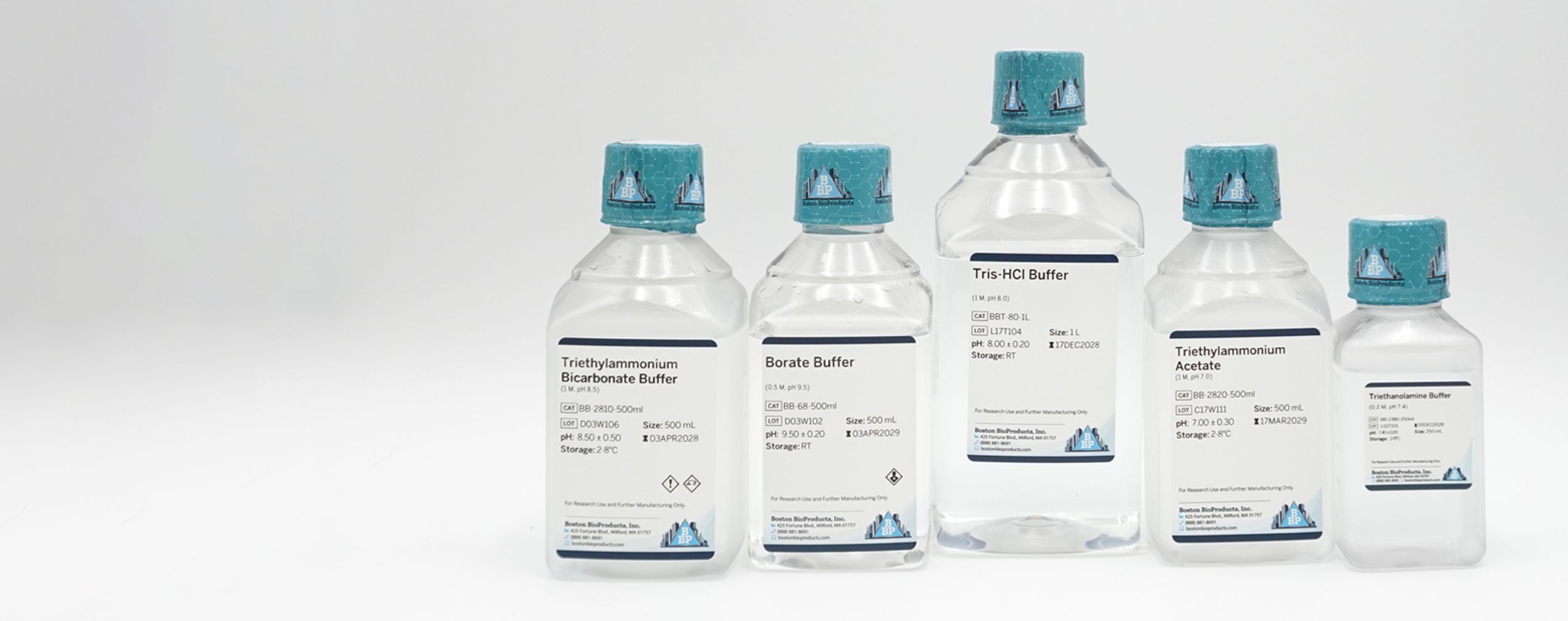
Achieve consistent retention times and sharp, well-resolved peaks with every run. Boston BioProducts provides high-purity, precisely formulated HPLC buffers designed to maintain optimal chromatography conditions, ensuring reliable, reproducible separations and peak performance every time.
Choosing an appropriate buffer for HPLC depends entirely on the method being used for separation. Usually during reverse phase separation, it's important to use a buffer with a pKa close to the pH of the buffer, preferably less than two units of the pH of the mobile phase.
In reverse phase HPLC separation, the pH of the buffer used changes the ionization of molecules in the sample. With nonpolar analytes, the change is small, and is much greater for polar molecules. Changes in analyte ionization will change the degree of separation and retention times of the molecules.
Buffers are used in HPLC to mitigate the influence of ionization of acidic or basic functional groups of analytes being separated. The buffer reduces fluctuations of pH, which would consequently cause unwanted influence on separation of the analytes.
The buffers used during HPLC influence the separation of analytes by influencing the binding to the stationary phase. Changing the buffer conditions will ultimately change the retention time of compounds to the stationary phase, and influence effective separation. This is why choosing the right buffer is so important.
Buffers are capable of maintaining pH by neutralizing acidic and basic ions. This maintains a specific pH, causing minimal shift despite the addition of compounds. This is important during chromatography because changes in pH could cause drastic differences in analyte separation.