Detergent solutions are widely used reagents in life science workflows because they help control interactions between hydrophobic and hydrophilic molecules in biological systems. Detergents function as surfactants that reduce surface tension and disrupt lipid membranes, enabling researchers to extract proteins, solubilize membranes, and improve assay performance.
In biochemical and molecular biology experiments, detergents play an essential role in processes such as cell lysis, membrane protein solubilization, electrophoresis, and immunoassays. Proper selection and optimization of detergent type and concentration can significantly influence experimental reproducibility and downstream analysis.
Detergents are amphipathic molecules containing both hydrophobic (water-repelling) and hydrophilic (water-attracting) regions. This dual structure allows them to interact with lipid membranes and hydrophobic biomolecules, forming micelles that keep otherwise insoluble components dispersed in aqueous solutions.
Because many cellular structures, such as membranes, are composed of lipids, detergents are frequently used to disrupt membranes, release cellular components, and stabilize proteins during extraction or purification.
Common roles of detergents in research
Cell lysis: Breaking cell membranes to release proteins, DNA, or organelles
Membrane protein solubilization: Forming micelles around hydrophobic regions to keep proteins soluble
Protein purification and stabilization: Preventing aggregation and improving yield
Reducing nonspecific binding: Lowering background noise in immunoassays or affinity purification
Electrophoresis preparation: Altering protein charge and structure to improve separation
How Do Detergents Work in Biological Systems?
Detergents disrupt biological membranes by inserting their hydrophobic tails into the lipid bilayer while their hydrophilic heads interact with the surrounding aqueous environment. This destabilizes membrane structure and allows membrane components to dissolve into detergent micelles.
In many experiments, detergents serve two main functions:
Membrane disruption and permeabilization
Allows intracellular components to be accessed for analysis.
Solubilization of hydrophobic molecules
Enables membrane proteins and lipids to remain soluble in aqueous buffers.
For example, the anionic detergent SDS (sodium dodecyl sulfate) unfolds proteins and coats them with a uniform negative charge, enabling accurate separation during SDS-PAGE electrophoresis.
Types of Detergents Used in Life Science
Detergents are typically classified according to the charge of their hydrophilic head group[1].
Image 1: Detergent Categories: nonionic, ionic, and zwitterionic
1. Ionic Detergents Ionic detergents are comprised of a hydrophobic hydrocarbon chain and a hydrophilic polar head group which contain either a negative (anionic) or positive (cationic) charge. Ionic detergents are widely used for the complete disruption of cellular structures, dissociation of protein-protein interactions and denaturation of proteins for separation during gel electrophoresis.
Anionic Detergents: Anionic detergents typically have negatively charged sulfate groups as the hydrophilic head. Examples of anionic detergents are as given below:
Sodium Dodecyl Sulfate (SDS)
Sodium Cholate Hydrate
Sodium Deoxycholate
Sodium Glycocholate
Sodium Glycodeoxycholate
Sodium Lauroylsarcosinate
Sodium Taurocholate
Sodium Taurodeoxycholate
Cationic Detergents: Cationic detergents contain a positively charged ammonium group, and include:
Cetyltrimethylammonium Bromide (CTAB)
Typical applications
Protein denaturation
SDS-PAGE electrophoresis
Complete cell lysis
Sodium Dodecyl Sulfate[2]: Detergent Mechanism:
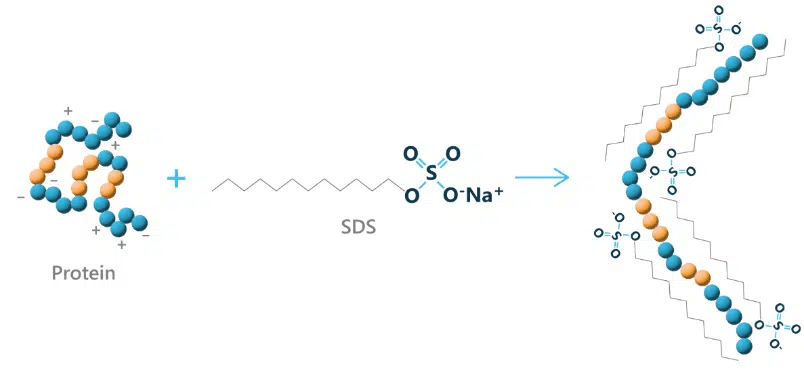
SDS is a well-known example of a detergent solution that has a direct impact on the denaturation of proteins, disruption of cell membranes, and electrophoresis. SDS is a key component of SDS-PAGE and a variety of other experiments. With a hydrophobic tail, a hydrophilic polar head, and a positively charged sodium ion, SDS dissociates in aqueous environments and leaves a net negative charge around proteins of interest.
The unique structure of SDS allows it to break hydrophobic interactions and hydrogen bonding within a protein’s native structure, as well as coat proteins in a uniform negative charge, forcing a linear protein chain and preventing stability and folding. This process is a key step in electrophoresis as fully denatured proteins are much more effective in migrating through polyacrylamide gel.
Image 2: The mechanism of SDS involves the leveraging of hydrophobic and hydrophilic structures to denature and apply a uniform negative charge to proteins.
2. Non-Ionic Detergents
Non-ionic detergents have uncharged head groups and are considered milder surfactants. They often preserve protein structure and biological activity.
Examples
Brij 35
n-Decyl β-D-glucopyranoside
n-Decyl-β-D-maltopyranoside
Digitonin
n-Dodecyl β-D-glucopyranoside
Hexyl β-D-glucopyranoside
IGEPAL CA-630 (NP-40 Substitute)
n-Octyl β-D-galactopyranoside
n-Octyl β-D-glucopyranoside
n-Octyl-β-D-thioglucopyranoside
Pluronic F-68 (Poloxamer 188)
Pluronic F-127 (Poloxamer 407)
Saponin
Triton X-100
Triton X-114
Tween-20 or Polysorbate-20 Tween-80 or Polysorbate-80
Typical applications
Membrane protein extraction
Immunoprecipitation
Immunoassays (ELISA, Western blot washing steps)
3. Zwitterionic Detergents
Zwitterionic detergents contain both positive and negative charges but have no net charge overall. They combine features of ionic and non-ionic detergents.
Detergent solutions are surfactant-based reagents used to manipulate lipid membranes, solubilize proteins, and reduce surface tension in biological experiments.
Detergents disrupt the lipid bilayer of cell membranes, allowing intracellular molecules such as proteins, DNA, and RNA to be released for analysis.
Ionic detergents are strong and often denature proteins, while non-ionic detergents are milder and typically preserve protein structure.
Yes. Some detergents interfere with techniques such as mass spectrometry, enzyme assays, or chromatography, so removal or optimization may be required.
Yes. Detergent formulations can be tailored for specific applications, including protein extraction, membrane protein stabilization, or analytical workflows.
Summary
Detergent solutions are essential tools in life science research because they enable researchers to manipulate biological membranes, solubilize proteins, and control biomolecular interactions. By understanding detergent types, strengths, and compatibility with experimental workflows, researchers can optimize sample preparation and improve experimental reproducibility.
Boston BioProducts Detergent Options & Custom Formulation
Browse our catalog of pre-formulated Detergent solutions (SDS, Tween 20, IGEPAL CA-640 etc.), each optimized for different applications