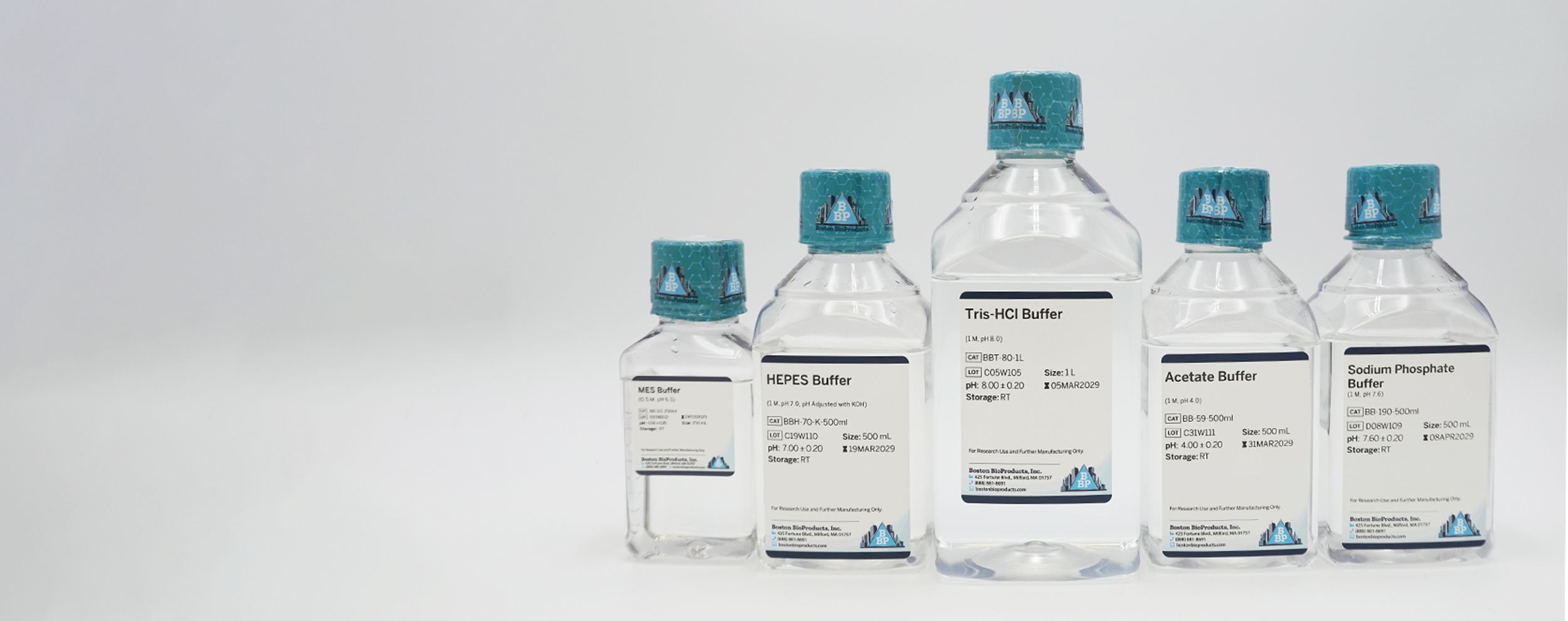
Optimize your FPLC performance with high-quality buffers from Boston BioProducts. Our expertly formulated solutions help deliver sharp peaks, pure fractions, and active proteins, supporting reliable, efficient protein purification every time.
FPLC protein purification works by flowing a buffer across a resin. Proteins have different affinities to the resin, causing them to flow through the resin at different rates. An FPLC is often equipped with a UV detector to visualize elution of proteins off of the instrument. The separated proteins can then be collected and used for further biochemical characterization.
FPLC purification is often difficult due to similarities in proteins of interest and other proteins in cell lysates. This leads to the need for multiple purification steps on multiple resin columns. Other issues come from particularly unstable proteins that misfold or become inactive during the purification process. Adjusting buffer salt concentrations and pH are common ways of troubleshooting this issue.
The most common types of buffers used in FPLC include: MOPS, HEPES, MES, tris, and phosphate buffers. Salt solutions like sodium chloride/potassium chloride in varying concentrations are commonly used. The specific pH range and salt concentration may vary based on the protein of interest being purified or the specific purification protocol used.
Purifying under well-buffered conditions with ideal ionic strength will improve solubility and purity of the protein. Consider using an affinity tag that can be removed to reduce the possibility of reduced activity due to non-native sequences. Finally, adding size-exclusion and ion-exchange chromatography steps may enhance the purity of your protein.
An FPLC is typically composed of four components: pump, column, detection system, and a fraction collector. The pump controls the pressure of flow of the buffer through the resin in the column. The column contains the stationary phase resin used for separation of proteins. The detection system usually contains at least UV detection to visualize elution of proteins off the column. The fraction collector collects aliquots in separate tubes off the column as the protein is eluted. All of these components work together for efficient FPLC protein purification.