
Poor band separation? Distorted bands? Protein aggregates? If you are frequently troubleshooting SDS PAGE, consider partnering with an expert. Boston BioProducts has you covered with best practices and infinitely-customizable buffer solutions.
The stacking gel has a lower concentration of acrylamide than the resolving gel, so proteins move through it more quickly. At the interface of the stacking and resolving gel, a pH gradient helps to "stack" the sample into a single band as it encounters the resolving gel. This stacking process improves band separation and resolution. The resolving gel has a higher concentration of acrylamide and a lower pH, causing proteins to move through it more slowly and separate proteins based on molecular weight.
Whether casting your own gels or purchasing precast gels is more suitable will depend on your needs. Some benefits of casting your own gels might include the ability to customize the gel composition, size, and thickness to meet your experimental needs, reduced cost, and flexibility to test multiple parameters or to change parameters frequently.
The concentration of acrylamide can be modified based on the protein(s) of interest. Larger proteins move more slowly through the gel than those with smaller molecular weights. Generally, low molecular weight proteins resolve best on higher percentage gels, while proteins with larger molecular weights should be run on lower gel concentrations. Gels can also be cast with a gradient of concentrations, which is particularly useful when there are multiple proteins of interest and they vary dramatically in size.
Gels can also be cast using different buffers (i.e., tris-glycine, tris-acetate, and bis-tris). Each of these is suitable for different proteins. Tris-acetate gels are the best choice for very large proteins. Bis-tris gels are the most stable and offer better resolution than tris-glycine gels.
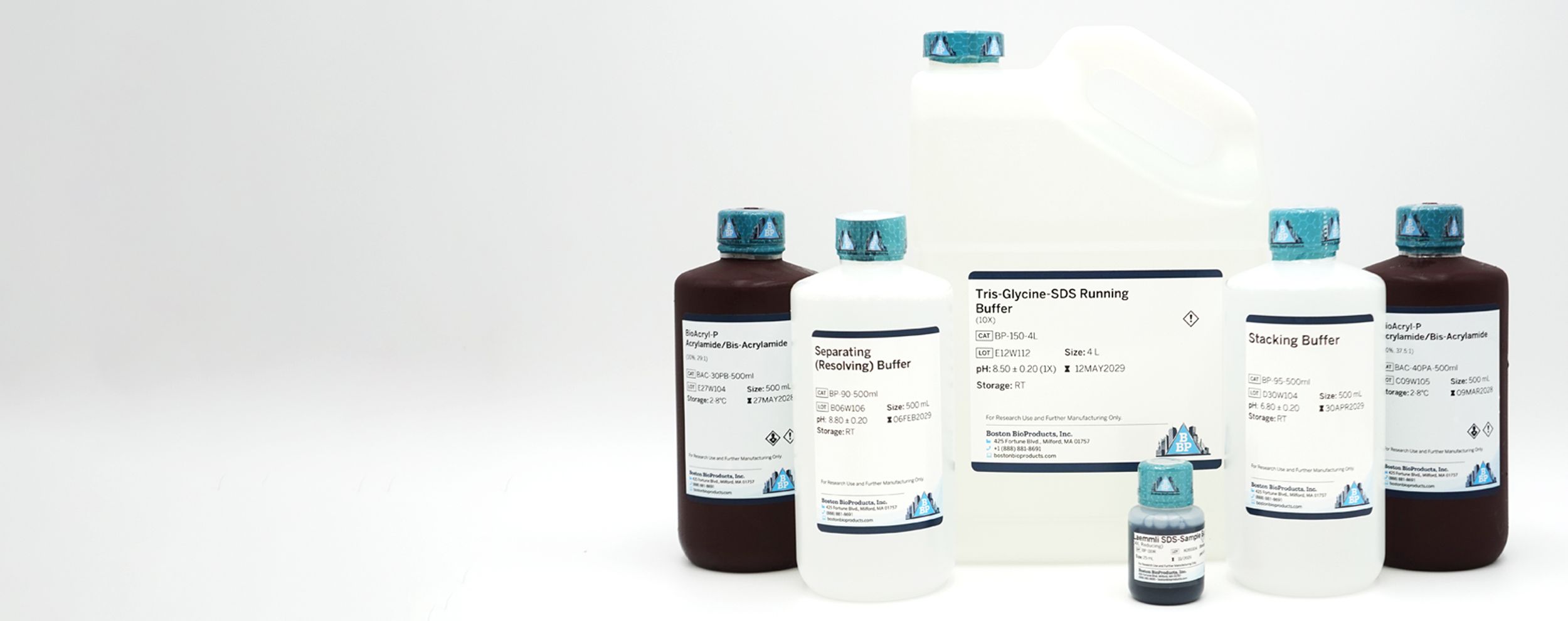
When selecting a running buffer, depending on which gel recipe used, there are specific buffer requirements and not all standard buffers will work for all gels. Bis-Tris gels require either MOPS or MES buffer as a reducing agent must be present in the running buffer. These two buffers offer different banding patterns. Gels run with MES buffer run more quickly because MES has a lower pKa than MOPS and may be more suitable for smaller proteins. Alternatively, because MOPS runs more slowly, it may offer better resolution. Tris-glycine gels are generally run with tris-glycine buffer. Tris-acetate gels require tris-acetate buffer and will not work with MOPS or MES buffers.
Several stains can be used to visualize proteins on a gel. Coomassie, silver stain, and fluorescent stains are commonly used for this purpose. Coomassie staining can be done more quickly, while fluorescent staining and silver stain are more sensitive.