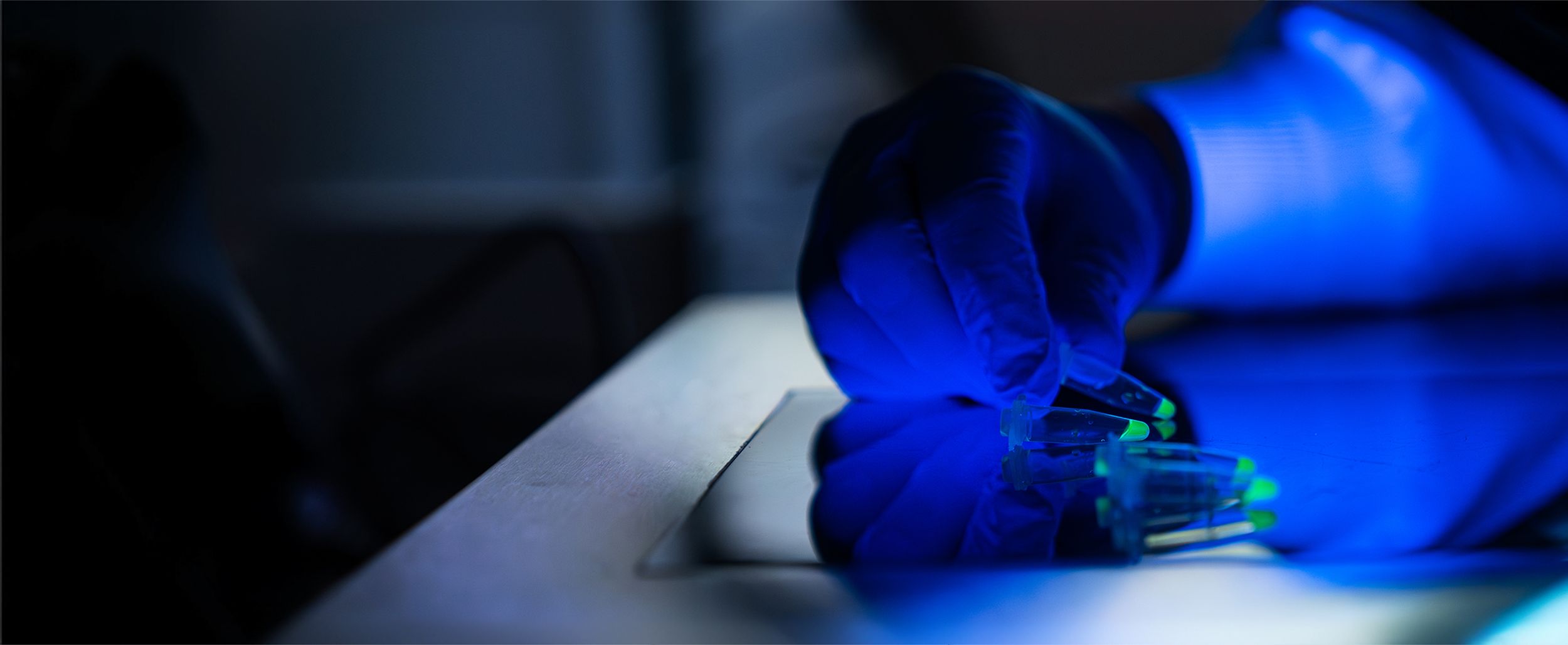
DNase Testing
DNase contamination can severely affect DNA experiments. Testing ensures your reagents are DNase-free for reliable results. Learn more about DNase testing for custom reagents.
DNase contamination can severely affect DNA experiments. Testing ensures your reagents are DNase-free for reliable results. Learn more about DNase testing for custom reagents.
Considerations and Limitations of DNase Testing | |
|---|---|
pH of Buffer Solutions | DNase, and DNase testing is optimal at neutral pH (6-8). Understanding your buffer sample is important, especially in this higher-risk range. |
High Salt Concentration | High salt solutions inhibit results of DNase testing as DNase activity is halted in high salt concentration. Dilutions of these solutions is necessary prior to performing the DNase Assay. |
Presence of Divalent Cations | DNase activity is inhibited by divalent cations such as Zn2+ Hg2+ Pb2+, Cd2+, As2+, and Cu2+. Whereas the divalent cations such as Mg2+, Mn2+ and Ca2+ are known to activate the DNases activity. |
Presence of Chelators | Chelators like EGTA and EDTA inhibit DNase activity. |
Reducing Agents | Reducing agents like β-mercaptoethanol, dithiothreitol (DTT), dithioerythritol (DTE), and glutathione (GSH) inhibit the DNase activity as the reduced enzyme is inactive. |
Detergent | SDS inhibits DNase activity. |
Chaotropic Agents | Chaotropic agents such as guanidine thiocyanate, guanidine hydrochloride and urea inhibit the DNase activity. |
Alkylating Agents | Alkylating agents such as iodoacetamide (IAA) and iodoacetate inhibit DNase activity. |
Gel Loading Buffers or Colored Solutions | Colored solutions interfere with DNase assays, especially if they contain SDS, EDTA, or β-mercaptoethanol. |