Loading product literature...
Nucleic acid hybridization is a foundational molecular biology technique used to detect, localize, or quantify specific DNA or RNA sequences through complementary base pairing [1, 2] . Hybridization buffers and solutions play a critical role in this process by creating the optimal chemical environment for stable and specific probe–target interactions.
Boston BioProducts’ hybridization buffers are designed to support a wide range of applications, including DNA hybridization, RNA hybridization, and in situ hybridization (ISH). Understanding how these buffers work, and how to choose the right formulation, can significantly improve signal strength, specificity, and reproducibility.
Nucleic acid hybridization is the process by which a single-stranded DNA or RNA probe binds to a complementary nucleic acid sequence through hydrogen bonding between base pairs. The process of hybridization typically involves a denaturation step to break the bonds of a double stranded nucleic acid, so each strand is capable of binding to an equally denatured probe.[3] This process is very specific, and must utilize the appropriate enzymes, buffers, solutions, and media unique to the cells of interest.[4]
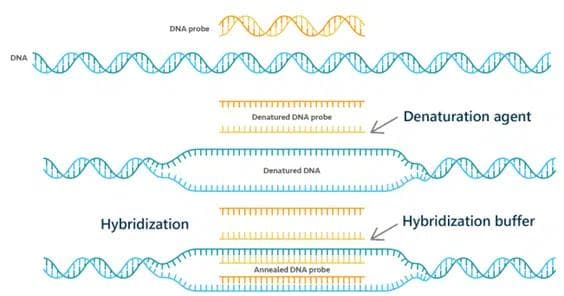
This process is widely used in applications such as:
DNA hybridization refers specifically to hybridization events involving DNA probes and DNA targets, though many principles overlap with RNA-based methods.
Nucleic acid hybridization relies on precise temperature, salt concentration, and denaturants—all controlled by the hybridization buffer.
A hybridization buffer is a specialized solution that promotes specific probe binding while minimizing non-specific interactions. It balances stringency, stability, and accessibility of nucleic acid strands.
Hybridization buffers typically:
Without the correct buffer composition, hybridization can result in weak signals, high background, or false positives.
Hybridization buffers influence nucleic acid interactions through several key mechanisms:
Choosing the correct hybridization buffer depends on your application, probe type, and experimental conditions.
Consider the following factors:
Application type
Probe and target
Stringency requirements
Boston BioProducts offers multiple hybridization buffer formulations designed to accommodate these variables.
Understanding these components can help troubleshoot and optimize your hybridization protocol.
Hybridization buffers influence nucleic acid interactions through several key mechanisms:
Weak or no signal
High background signal
Poor reproducibility
Optimizing hybridization buffer composition and conditions is often the most effective way to resolve these issues.
Unlike lysis buffers or wash buffers, hybridization buffers are specifically engineered to:
Using a general-purpose buffer in place of a hybridization buffer can significantly compromise results.
Every Hybridization Buffer is unique to the cell type used and the experimental application. Select the appropriate Hybridization Buffers from the catalog or design your optimal formulation with custom manufacturing options at Boston BioProducts.
Component Type | Purpose In Hybridization | Common Examples |
|---|---|---|
Formamide | Lowers the melting temperature (Tm) of nucleic acid strands, enabling controlled strand separation and re-annealing while improving specificity and reducing background signal. | Formamide |
Buffering agents | Maintain stable pH conditions during hybridization, which is critical for nucleic acid stability and reproducible hybridization kinetics. | Tris-acetate-EDTA (TAE), Saline-Tris-EDTA (STE), Saline-sodium citrate (SSC) |
Salts | Provide ionic strength to stabilize nucleic acid structures and support probe–target interactions. Salt concentration is adjusted based on nucleic acid type and desired stringency. | |
Detergents | Reduce surface tension and prevent nucleic acid aggregation. Detergents also help remove excess probe and minimize non-specific binding. | |
Blocking agents | Minimize non-specific binding and background signal by occupying reactive sites on membranes or surfaces used during hybridization. | Bovine serum albumin (BSA), salmon sperm DNA, calf thymus DNA, yeast tRNA |
Labeling agents | Enable detection of hybridized probe–target complexes through radioactive, enzymatic, or fluorescent signals. | Radioactive: ³²P, ³⁵S, ³H Enzymatic: alkaline phosphatase, horseradish peroxidase Fluorescent: fluorescein, rhodamine |